Describe the Following Natural Classes of English Sounds
A natural class is a group of sounds described by a small number of distinctive features Natural classes can be defined by and feature. It also contains a list of words that denote the sounds produced by inanimate objects and sounds in nature.

Pin On Esl
The sound that is represented by the letter sh in the word shoe is a consonant and the sound represented by the letters oe in the word shoe is Vowel.

. This will be discussed under the type of consonants in this chapter. Consonantal stop - nasal bilabial d t. In Sindhi p h p and b are separate phonemes.
A word like through has seven letters t-h-r-o-u-. In Modern English as you know the fricatives f v θ ð s z are six different phonemes. English contains an allophonic rule that determines.
Consonantal stop - nasal bilabial d t. Describe the following natural classes of English sounds using shared distinctive features. To what natural class do the following consonants belong.
By contrast Kenstowicz and Kisseberths examples of unnatural classes consist. For a group of sounds to constitute a natural class they must all share one or more features and. W j w high tense vowel.
Velar oral stops c. In English p and b are separate phonemes and ph is an allophone of p. Voiced alveolar liquids f θ s ʃ h.
21 Sounds of English The study of the sounds of human language is called phonetics. A natural class is a set of sounds that have certain phonetic features in common. Natural classes can generally be given simple phonetic characterizations eg.
Describe the following natural classes of English sounds. Due Wednesday October 7 in class Question 1. Sound Segments Knowing a language includes knowing the sounds of that language Phonetics is the study of speech sounds We are able to segment a continuous stream of speech into distinct parts and recognize the parts in other words.
Voiceless sibilants Question 2. A _____ r l b _____ f θ s S h c _____ w j d _____ p b e _____ tS dZ S Z r. The most commonly known Natural Classes of phonological sounds in Modern American English as taught in my Linguistics 101 course.
Voiceless fricatives w j. Well see how in a couple of minutes. But in Old English these six segments were categorized as only three different phonemes each with a voiced and a voiceless allophone f v θ ð s z.
Remember phonology has to do with what sounds are produced in a language as well as how they are organized. To what natural class do the following consonants belong. The following is a list of sound words that denote animal sounds and bird cries.
P t b g ʃ s f v θ ð tʃ dʒ i ɪ i ɪ u ʊ p k f θ tʃ s ʃ tʃ k g ŋ n t d. P t k ʔ. F θ s ʃ h glides.
Grinding a sound of one hard thing moving against another. W and j in English. 2 f θ s ʃ h.
Inaudible a sound that is difficult to hear. Sounds in the sense that we discuss them are totally different from letters. Phonology is concerned with the properties of sounds and the ways that they are combined into words.
The classification of sounds into vowels and consonants is customary irrespective of phonetic phonological or orthographic references. Consonantal stop - nasal alveolar 1 m n. There should be no other sounds in the language that have this feature or combination of features.
Hushed a sound that is quiet. High tense vowels p b. Terms in this set 57 p b.
Non-front lax vowels d. Phonological processes Identify the phonological process give the most general name we have discussed in each of the. The given sounds may not include all the members in the natural class.
Z ʒ voiced liquid. Some of the noises that animals make have interesting names in English. A liquid consonant is one in which the tongue partially closes the mouth resulting in a resonant vowel-like consonant such as the English l and r.
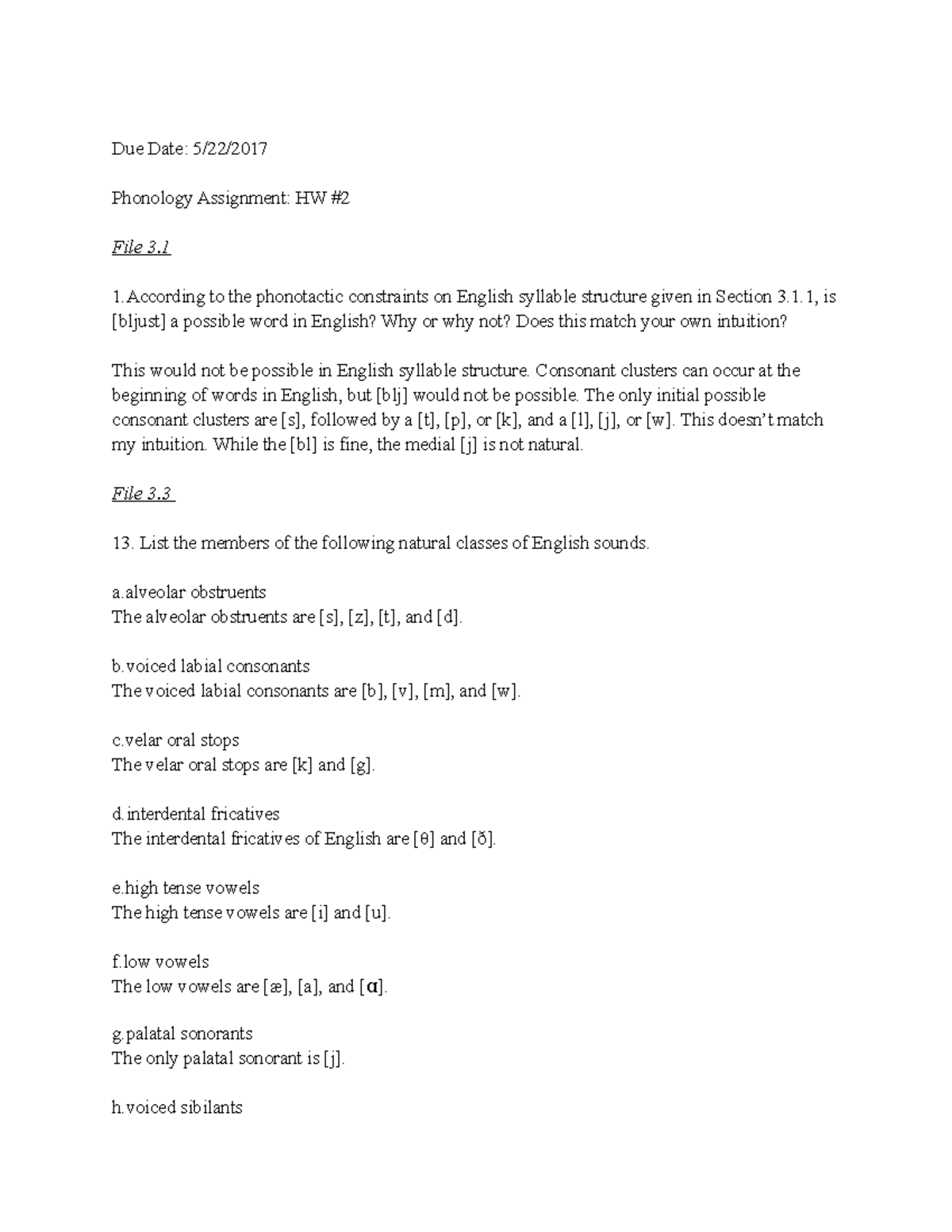
Voiced glides i u. Search a word to find more about the sounds of animals and birds. Natural classes List the members of the following natural classes of English sounds.
The following words from Old English show the distribution of these segments. Describe every speech sound in every human language. This next set of features has to do with the manner of articulation.
Therefore both languages have the same 3 sounds same. The feature continuant tells us how long a sound goes on. Identify the natural classes of the following English sounds Note.
2 f θ s ʃ h. Consonantal stop - nasal alveolar 1 m n. Muffled a sound that is not easy to hear because it is blocked by something.
The current classification following Pike divides the sounds into vocoids vowel sounds contoids consonant sounds and semi-vocoids or semi-contoids for example. Monotonous a sound that is always the same and never gets louder or quieter or higher or lower. Phonology of English regarding voiceless stops.
These first three features consonant sonorant and syllabic allow us to group all speech segments into the major classes of consonants vowels and glides. P t k are voiceless stops m n are nasal stops and i e ä are front vowels. O Describe the following natural classes of English sounds ɹ l.
Describe the following natural classes of English sounds using shared distinctive features. ɺ l voiceless fricative. All sounds during the production of which we hear friction are consonants but not all consonants are produced with friction.

Pin On Random Stuff

Pin On Learning English

Pin On Learning English
Phonology Ling 1150 Introduction To Language And Linguistics Nu Studocu

Pin On Focus

Pin On English Pronunciation And Accent Reduction

Pin On Slp Lesson Plans Activities

Pin On Collocations
Pin On Tajweed


Comments
Post a Comment